Flowers of the Bible: what scholars say the lily, rose and hyssop really were
Ask ten people to picture the “lily of the field” from the Sermon on the Mount and most will describe a white Easter lily. Botanists who have walked the hillsides of Galilee tend to describe something else entirely. The flowers of the Bible are a good example of how translation, tradition and field botany can pull a single word in three directions. Here is what scholars have concluded about three of the best-known plants: the lily, the rose and hyssop.
Why plant names in Scripture are so slippery
Biblical Hebrew had a limited vocabulary for plants, and a single word often covered several species with a similar look or use. Translators then made choices. The King James Version of 1611 used plants familiar to English readers, so “rose” and “lily” went in even where the original meaning was probably something else.
Researchers such as Michael Zohary, a Hebrew University botanist whose work on the flora of the Bible remains widely cited, took a different approach. They asked what actually grows in Israel, Sinai and Egypt, what the text says about habitat, season and use, and what later Jewish and Greek traditions record. The answers are often probable rather than certain, and good scholars say so.
The lily: probably not the one on your Easter table
The Hebrew word is shoshan (or shoshannah). It shows up in the Song of Songs, where the beloved is “a lily among thorns” and lips are compared to lilies dripping with myrrh. In the New Testament, Jesus points to the “lilies of the field” (Greek krinon) in Matthew 6:28.
Candidates include:
- Madonna lily (Lilium candidum). This is the classic Christian “lily,” but it is rare in the wild in the region and may not have been what the writers meant.
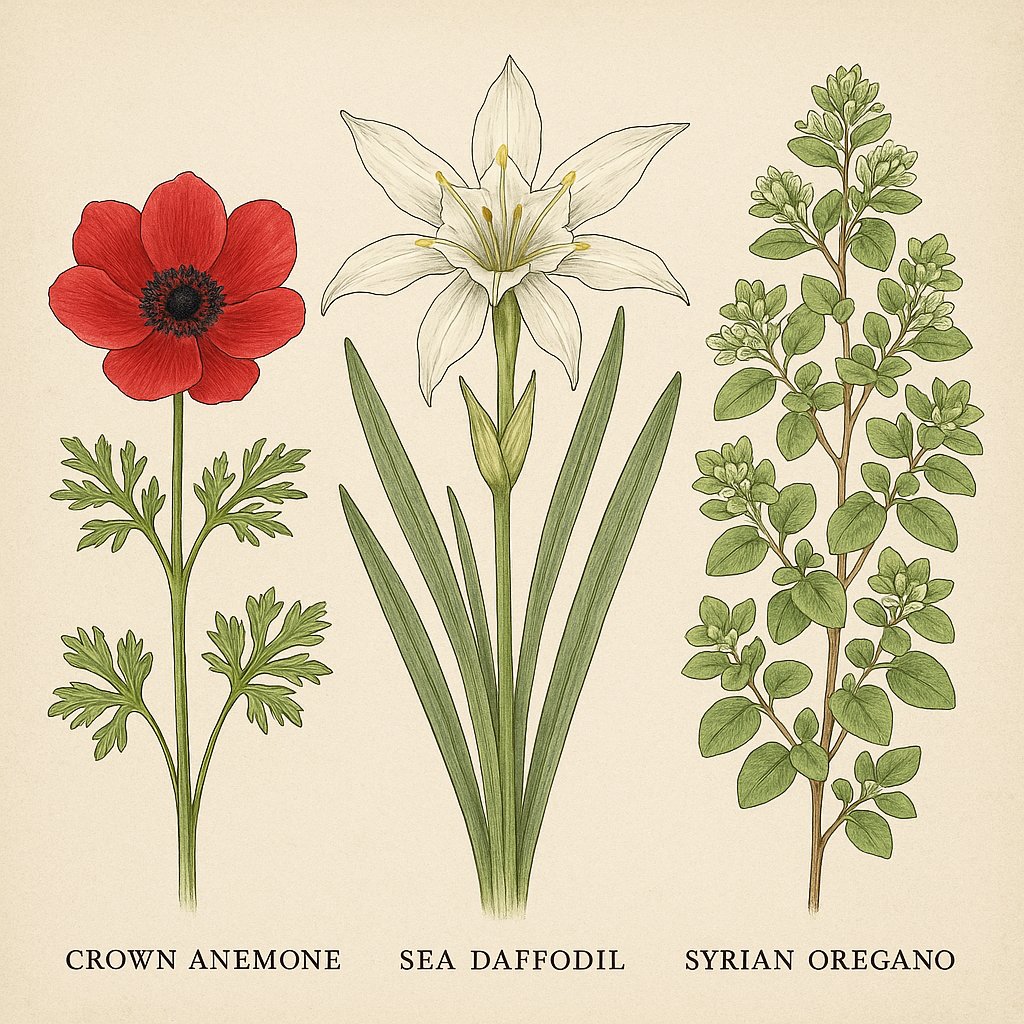
- Crown anemone (Anemone coronaria). It blankets Galilean hillsides in winter and spring in red, purple and white. Many modern botanists favor it for Matthew 6:28, since Jesus describes a showy flower of open fields that is soon cut and burned.
- Egyptian lotus or water lily (Nymphaea). This fits the “lily work” on the temple pillars in 1 Kings 7, since lotus imagery was common in ancient Near Eastern architecture.
- Iris, hyacinth or sea daffodil. Each has been proposed for various verses.
The likeliest conclusion is that shoshan was a flexible word for any striking, lily-shaped or cup-shaped flower. I find that more satisfying than a single answer. Jesus was pointing at what his listeners could see on the hillside, not naming a species for a field guide.
The “rose of Sharon” that may be no rose at all
In Song of Songs 2:1 the speaker says, “I am the rose of Sharon, and the lily of the valleys.” The Hebrew is chavatzelet, and it also appears in Isaiah 35:1, where the desert “shall blossom as the rose.” Wild roses do exist in the region, but nothing in the Hebrew text clearly points to one.
The strongest candidates are bulbs that flower on the coastal plain of Sharon:
- Sea daffodil (Pancratium maritimum). A white, fragrant flower that grows in the coastal sand dunes.
- Tazetta narcissus (Narcissus tazetta). A winter-flowering, highly scented plant long associated with the area.
- Autumn crocus or meadow saffron (Colchicum, Crocus). These come up in Isaiah’s desert-blooming imagery, where bulbs bursting from dry ground make for a vivid picture.
Real roses do appear in the texts that Catholic and Orthodox Bibles include. Sirach and the Wisdom of Solomon use the Greek rhodon, as in “let us crown ourselves with rosebuds” (Wisdom 2:8). That is much later Greek-language material, written when rose culture had spread across the Mediterranean.
Hyssop: a humble herb with a heavy job
Hyssop (Hebrew ezov) carries the most ritual weight of the three. Israelites used a bundle of it to daub lamb’s blood on their doorposts at the first Passover. It appears in purification rites for skin disease and for contact with the dead, and in Psalm 51:7: “Purge me with hyssop, and I shall be clean.”
The garden herb sold today as hyssop (Hyssopus officinalis) is not a strong match. It is mostly a plant of southern Europe and does not clearly belong to the Israeli landscape. Two better candidates have emerged:
- Syrian oregano (Origanum syriacum). This is the leading identification. It is aromatic, grows wild in rocky crevices, has soft, leafy stems that hold water well for sprinkling, and is the main ingredient in the spice blend za’atar.
- Caper bush (Capparis spinosa). It is occasionally proposed because 1 Kings 4:33 says hyssop grows “out of the wall,” and capers famously do.
The New Testament adds a puzzle. John 19:29 says a sponge was lifted to Jesus on hyssop, while Matthew and Mark say a reed. Some scholars point out that a woody oregano stem would be too short and weak, and suggest a different plant, such as a sorghum stalk, or a scribal variation in the Greek. The question is still debated.
Quick comparison
| Bible word | Hebrew or Greek | Common English reading | Leading scholarly candidates |
|---|---|---|---|
| Lily | shoshan / krinon | White lily | Crown anemone, Madonna lily, lotus |
| Rose of Sharon | chavatzelet | Rose | Sea daffodil, tazetta narcissus, crocus |
| Hyssop | ezov / hyssopos | Garden hyssop | Syrian oregano, possibly caper |
What to take from all this
The takeaway is not that the translations are wrong. The poetry works whether the flower in the verse is an anemone or a lily. But knowing the likely plants changes how the passages read. The “lily” becomes a scarlet wildflower that disappears in a week. The “rose” becomes a dune bulb scenting the coast. Hyssop turns out to be the oregano in a Middle Eastern pantry, humble and everywhere, which is part of why it suits a ritual of ordinary people.
If this has sparked your curiosity, a good next step is to read these passages in two or three translations side by side, and check the footnotes in a study Bible. Many US botanical gardens also keep biblical or Holy Land plant collections, and seeing Syrian oregano or a crown anemone in person can do more than any description.